
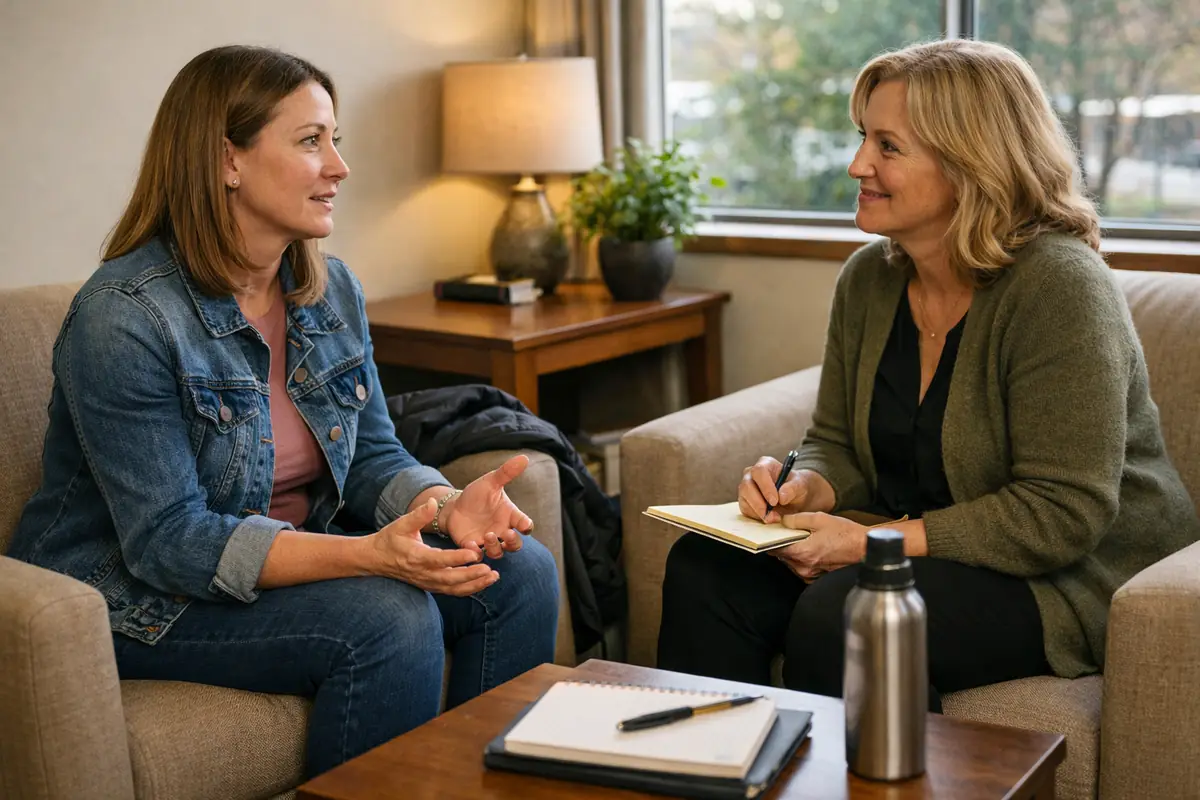
Women's IOP After Residential Treatment
Learn how women's IOP after residential treatment can support ongoing recovery, mental health care, and daily life after a higher level of care.
Reviewed by clinical staff
On this page
- What is a women’s IOP after residential treatment?
- Why the transition period matters
- How IOP can support women’s mental health, trauma, and substance use recovery
- What to look for in a women’s IOP after residential treatment
- How IOP compares with PHP and standard outpatient care
- What treatment planning may involve at Women’s Recovery in Denver
- Frequently asked questions
Leaving residential treatment can bring relief, hope, and understandable uncertainty. Many women feel stronger after a structured stay, yet also recognize that returning home, work, parenting, school, or relationships can add new stress. A women’s IOP after residential treatment can serve as a practical next step, offering continued clinical support while making room for real life. For many people, this level of care helps bridge the transition between intensive treatment and greater independence.
Women’s Recovery offers women-only partial hospitalization (PHP) and intensive outpatient (IOP) care in Denver. Explore all programs or call 833.754.0554.
At Women’s Recovery in Denver, Colorado, women can receive outpatient care for substance use, mental health concerns, and trauma in a women-only setting. Treatment options include Partial Hospitalization, Intensive Outpatient, and outpatient services. The right level of care depends on an individual assessment, including current symptoms, recovery stability, safety needs, daily responsibilities, and treatment history. For women and families researching what comes after residential care, it can help to understand what IOP is, when it may fit, and how it supports continued healing.
What is a women’s IOP after residential treatment?
An intensive outpatient program, or IOP, is a structured form of outpatient treatment that offers more support than standard weekly therapy, while allowing a person to live at home or in supportive housing. In a women’s IOP after residential treatment, care often includes group therapy, individual sessions, treatment planning, psychoeducation, relapse prevention, and support for co-occurring mental health concerns. The goal is not to recreate residential care, but to extend treatment in a way that fits daily living.
For women stepping down from a residential setting, IOP can provide continuity during a vulnerable transition period. Residential treatment offers a contained environment with around-the-clock structure. Once that structure changes, triggers, family dynamics, transportation, employment stress, and community access can all affect recovery. An IOP creates regular clinical contact and accountability while helping women practice coping skills in the settings where long-term recovery actually happens.
Why the transition period matters
The time after residential treatment is often a period of adjustment. A woman may be re-entering familiar routines while trying to protect new progress in sobriety, emotional regulation, and self-understanding. She may also be navigating trauma responses, depression, anxiety, grief, or relationship strain. According to the Substance Abuse and Mental Health Services Administration, continuing care is an important part of recovery support, especially after a higher level of care. Ongoing treatment can help maintain momentum and reduce the sense of being suddenly on one’s own.
Families may assume that completing residential treatment means the work is done. In reality, recovery and mental health stabilization usually require continued attention over time. A step-down level of care can help women identify risks early, strengthen routines, and build confidence gradually. It also creates space to process what comes up after discharge, including shame, ambivalence, fear of relapse, and practical challenges that may not have been fully visible during a residential stay.
Common reasons women may benefit from IOP after residential treatment include:
Needing continued structure and accountability while returning home
Managing co-occurring trauma, anxiety, depression, or mood symptoms
Practicing coping skills in work, family, school, or parenting environments
Building relapse prevention strategies with ongoing clinical support
Strengthening healthy relationships and boundaries in everyday life
- Needing continued structure and accountability while returning home
- Managing co-occurring trauma, anxiety, depression, or mood symptoms
- Practicing coping skills in work, family, school, or parenting environments
- Building relapse prevention strategies with ongoing clinical support
- Strengthening healthy relationships and boundaries in everyday life
Comparison of common step-down treatment levels
| Level of care | Best fit | Structure | Living situation |
|---|---|---|---|
| PHP | Needs high support after residential | Most structured outpatient | Lives at home or supportive housing |
| IOP | Needs steady support with more independence | Moderate structure | Lives at home or supportive housing |
| Outpatient | Stable with lower-intensity needs | Least structured | Lives independently |
| Residential | Needs 24-hour therapeutic setting | Highest structure | Lives on-site |
| Assessment | Used to determine fit | Guides recommendations | Varies by need |
How IOP can support women’s mental health, trauma, and substance use recovery
Many women entering treatment are not dealing with only one issue. Substance use may be connected with trauma, chronic stress, eating concerns, anxiety, depression, or patterns in relationships that developed over years. A women-only IOP can offer space to explore these concerns with peers who may share similar life experiences. That setting can feel more emotionally safe for some women, especially when trauma, shame, caregiving strain, or relationship harm have played a role in their history.
A strong IOP does more than focus on abstinence alone. It should address the whole person, including emotional health, physical well-being, coping patterns, family roles, and social support. Treatment may include relapse prevention, trauma-informed therapy, skill building, and attention to daily functioning. Care decisions should always follow an assessment so that treatment intensity matches actual needs. For some women, IOP is an appropriate next step; for others, PHP or standard outpatient care may be a better fit.
What to look for in a women’s IOP after residential treatment
Not every outpatient program is the same. When evaluating options, families often focus first on logistics, but clinical fit matters just as much. It is helpful to ask whether the program treats both substance use and mental health concerns, whether trauma is addressed in a thoughtful way, and how progress is reviewed over time. An assessment should guide recommendations, rather than placing everyone in the same track regardless of need.
It can also help to ask how the program supports real-life transitions. Women leaving residential care may need help with boundaries, recovery planning, community support, medication coordination with outside providers, or returning to responsibilities without becoming overwhelmed. In many cases, a step-down plan works best when it is individualized and adjusted as someone progresses.
Questions to consider when comparing IOP options:
Does the program provide care for substance use, mental health, and trauma together?
Is treatment delivered in a women-only environment, if that is important to you?
How does the program decide between PHP, IOP, and outpatient care?
What kinds of therapy, education, and relapse prevention support are included?
How is family involvement handled, when appropriate and clinically helpful?
- Does the program provide care for substance use, mental health, and trauma together?
- Is treatment delivered in a women-only environment, if that is important to you?
- How does the program decide between PHP, IOP, and outpatient care?
- What kinds of therapy, education, and relapse prevention support are included?
- How is family involvement handled, when appropriate and clinically helpful?
Ready for more support? Our women’s IOP and women’s PHP are built for adult women balancing recovery with real life. Call 833.754.0554 to start an assessment.
How IOP compares with PHP and standard outpatient care
A common question after residential treatment is whether IOP is the right level of support, or whether a woman may need more or less structure. The answer depends on her current symptoms, safety, substance use risk, functioning, housing stability, supports, and treatment goals. The American Society of Addiction Medicine emphasizes matching care intensity to individual needs rather than using a one-size-fits-all approach. That is why a full assessment is important before starting any program.
In general, PHP offers a higher level of structure than IOP, while standard outpatient care offers less frequent support. IOP often sits in the middle: enough treatment contact to provide meaningful accountability and skill practice, with enough flexibility to support daily life. As progress continues, some women step down from IOP to outpatient therapy and ongoing recovery support.
What treatment planning may involve at Women’s Recovery in Denver
Women’s Recovery offers women-only outpatient treatment in Denver for substance use, mental health concerns, and trauma, with Partial Hospitalization, Intensive Outpatient, and outpatient services available. For a woman leaving residential treatment, the first step is determining what level of care is clinically appropriate now. That recommendation should follow an assessment that looks at current symptoms, recent substance use, relapse risk, emotional stability, support systems, and the demands of everyday life.
An individualized plan may include group therapy, individual therapy, education, and support for co-occurring concerns. It may also include planning for daily routines, triggers, and transitions between levels of care as needs change. For families, it can be reassuring to know that stepping down to outpatient treatment does not mean treatment is ending. Instead, it often means care is continuing in a way that helps recovery take root in the community where life is actually being lived.
Related reading
- Women's Intensive Outpatient Program Guide
- How Many Hours Is Women’s IOP?
- Women's Mental Health IOP
- Online vs In-Person IOP for Women
- What Is Women's IOP?
If you or someone you love is looking for a women’s IOP after residential treatment, Women’s Recovery in Denver can help you explore next steps with care and clarity. Because treatment needs vary, recommendations should follow an assessment of current symptoms, recovery stability, and support needs. To learn more about women-only PHP, IOP, or outpatient treatment, call 833-754-0554.
Women-only treatment in Denver. Take the first step today.
You don’t have to wait until things get worse. Talk with our admissions team about PHP, IOP and outpatient programs. Call 833.754.0554.
Frequently asked questions
How soon should someone start IOP after residential treatment?
In many cases, starting soon after discharge can help maintain continuity and reduce gaps in support. The ideal timing depends on the person’s clinical needs, discharge plan, housing, transportation, and overall stability. A treatment assessment can help determine whether IOP should begin right away or whether another level of care is more appropriate.
Is IOP only for substance use, or can it help with mental health too?
IOP can be used for substance use treatment, mental health treatment, or both, depending on the program. For many women, co-occurring conditions such as trauma, anxiety, depression, or mood symptoms are closely connected to substance use. An integrated approach may be especially helpful when these concerns affect one another.
What if a woman is not sure IOP is enough support after residential care?
That uncertainty is important to discuss during the assessment process. Some women benefit from stepping down to PHP first, while others are appropriate for IOP or standard outpatient care. The recommendation should reflect current symptoms, safety concerns, relapse risk, daily functioning, and the amount of structure needed to support stability.
Can family members be involved in treatment planning?
Family involvement may be part of treatment when it is clinically appropriate and when the client wants that support included. In some cases, family participation can help with communication, boundaries, education about recovery, and discharge planning. The role of loved ones should fit the individual’s needs, history, and treatment goals.
How do I find out whether Women’s Recovery is the right fit?
A good first step is to contact the program and ask about the assessment process, levels of care, and whether treatment may fit the woman’s current needs. Because recommendations should follow an assessment, a conversation can help clarify whether PHP, IOP, or outpatient care is the most appropriate next step after residential treatment.