Available within our partial hospitalization program (PHP)

Some women enter treatment before they are ready to put everything into words. Talking in a group may feel like too much at first, and that does not mean they are unwilling to heal. Acudetox offers a quiet, nonverbal way to take part without sharing personal experiences or speaking in front of others.

Available as an optional service within Women’s Recovery’s partial hospitalization program in Denver, Acudetox follows the National Acupuncture Detoxification Association, or NADA, ear protocol. During a session, a trained professional places small, sterile, single-use needles at specific points on the outer ear while participants sit together for about 30–45 minutes. No personal disclosure or discussion is required.

woman hugging another woman

Acudetox is not medical detox. It is a complementary service and does not replace psychotherapy, medication, withdrawal management, or medical care. Participation and eligibility are individualized, and not every PHP client will receive or benefit from Acudetox.

Women-focused care | Denver location | Optional participation | Clinically integrated support

What is Acudetox?

Acudetox is a standardized, nonverbal form of auricular acupuncture used as a complementary service within behavioral health and substance use treatment. It is also known as the NADA ear protocol, the five-point protocol, or 5NP. Some programs use the related term AcuWellness.

During the standard protocol, fine needles are placed at designated points on the outer ear while participants sit quietly in a group for about 30–45 minutes. Women’s Recovery uses Acudetox within comprehensive substance abuse treatment for women, not as a stand-alone intervention.

The NADA protocol grew from community-based substance use work at Lincoln Hospital in the Bronx during the 1970s. It has since been adopted in a range of addiction, behavioral health, and trauma-aware settings as an adjunct to counseling, medical support, and other treatment services.¹

The Women’s Recovery approach
Setting A quiet group experience integrated into outpatient PHP care
Approximately 30–45 minutes Approximately 30–45 minutes
Needles Small, sterile, single-use needles placed at designated outer-ear points
Talking required No personal sharing, discussion, or emotional processing is required
Participation Optional and based on individual appropriateness
Role in treatment A complementary service, not medical detox or a replacement for clinical care

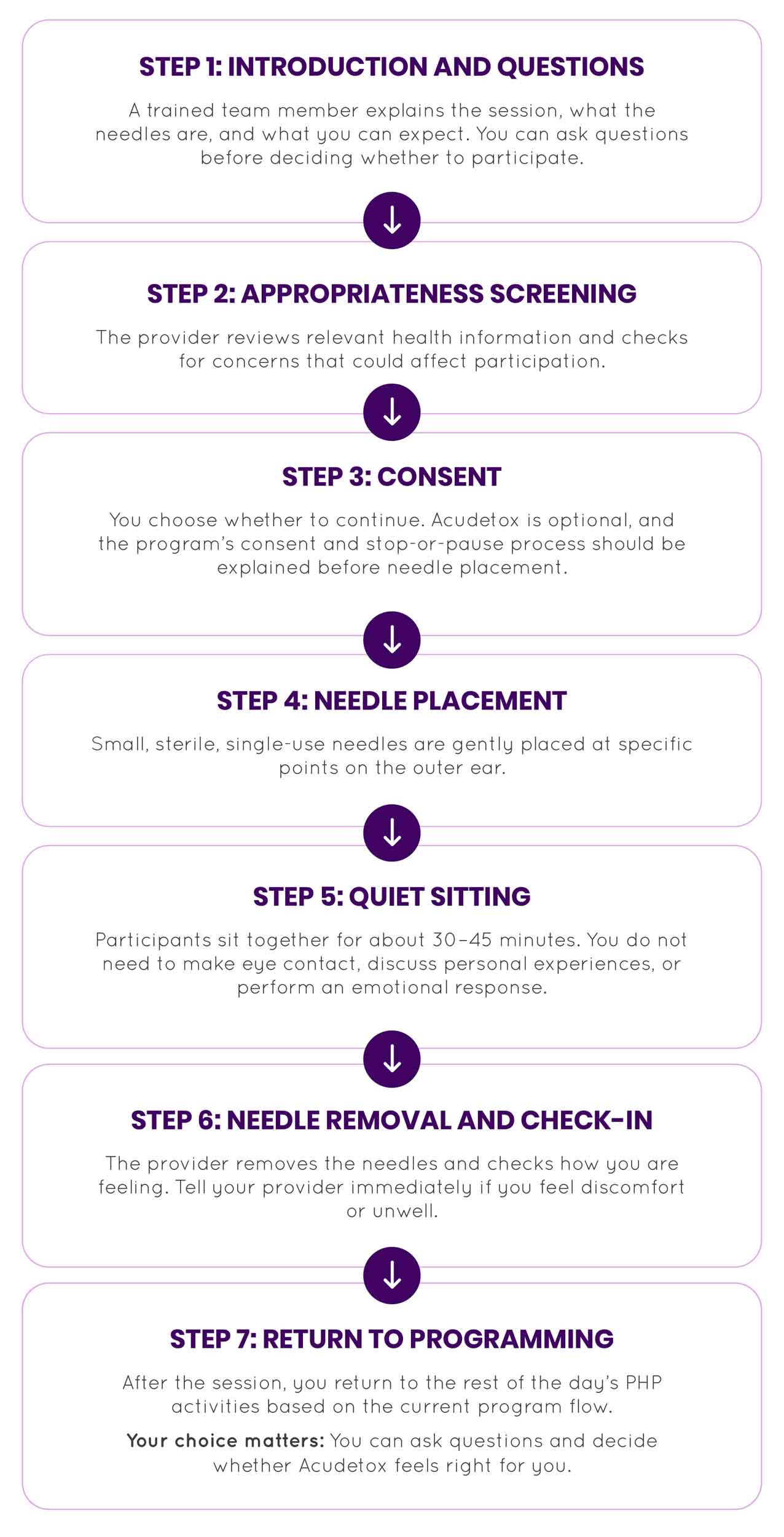
What happens during an Acudetox session?

Acudetox steps
Acudetox steps

What the evidence can and cannot tell us

Acudetox has been used in behavioral health settings as a complementary practice, and some participants describe feeling calmer, more present, or more able to remain in the treatment environment. Individual experiences vary, and those reports do not establish Acudetox as a treatment for substance use disorders, withdrawal, trauma, anxiety, or sleep problems on its own.

Research on acupuncture depends on the condition, protocol, and quality of the study. The National Center for Complementary and Integrative Health notes that results vary and that safe delivery matters. At Women’s Recovery, Acudetox remains one optional tool within clinical care, not a replacement for evidence-based treatment or medical services.²

Acudetox and trauma-informed treatment

Trauma can affect how safe or accessible verbal processing feels. Someone may want help and still have difficulty speaking, making eye contact, or joining a discussion. Because Acudetox is quiet and predictable, it may offer a lower-demand entry point for some women while they build trust in the treatment setting.

Acudetox does not treat trauma itself. It can complement therapeutic work within a trauma treatment program for women, a PTSD treatment program, or a broader mental health treatment program. Psychotherapy, psychiatric care, and other clinically indicated services remain central.

Some participants describe feeling calmer or more present during or after a session, while others may notice little change or decide that the service is not for them. The goal is to offer choice, predictability, and a quiet way to remain connected to the treatment community without requiring conversation.

Choice

Participation is optional, and each client can ask questions before deciding.

Predictability

The session follows a simple process with clear expectations and a defined time frame.

Quiet connection

Clients can sit alongside others without sharing, speaking, or performing an emotional response.

Safety, side effects, and who provides Acudetox

Acudetox uses sterile, single-use needles. Before a session, the provider screens for relevant health concerns, explains the process, and obtains consent. Clients should tell their provider about pregnancy, medical conditions, medications, and any irritation, infection, injury, hearing device, or piercing near the ear.

Minor effects can include brief discomfort, tenderness, slight bleeding, bruising, or lightheadedness. A participant who feels unwell should tell the provider right away so the session can be stopped and the program’s escalation process can be followed.

Proudly serving the Denver metro area and beyond

Women’s Recovery provides Acudetox within the PHP at our Denver outpatient center:

Women’s Recovery – Denver

3801 E Florida Ave., Suite 650
Denver, CO 80210
Phone: 833.754.0554

Our location is near Cherry Creek, Washington Park, and the University of Denver, with convenient access from Colorado Boulevard and I-25.

Women may travel from nearby Denver neighborhoods such as Cherry Creek, Washington Park, Baker, Capitol Hill, the Highlands, and Sloan’s Lake. We also serve clients from Aurora, Englewood, Lakewood, Littleton, Centennial, and Highlands Ranch, generally within a 25- to 30-mile drive depending on the starting point and traffic.

Nearby ZIP codes include 80210, 80209, 80206, 80220, 80222, and 80246. Estimated drive times commonly range from about 5–10 minutes from Cherry Creek, around 10 minutes from Washington Park, 10–15 minutes from Baker or Capitol Hill, and 15–20 minutes from the Highlands or Sloan’s Lake. Travel times vary.

Why Women’s Recovery offers Acudetox within PHP

Women’s Recovery follows a by-women, for-women model built around safety, connection, and individualized care. Some women begin treatment feeling guarded, emotionally tired, or unsure how to speak about what has happened. Acudetox gives eligible clients another way to remain present in the treatment environment when immediate verbal processing feels out of reach.

The service is one tool within the Women’s Recovery partial hospitalization program. Individual and group psychotherapy, psychiatric care, medication support when clinically indicated, and other evidence-based services remain central.

Acudetox may provide a quiet pause that helps some clients feel ready to return to those parts of care, but it is not the reason the program works, and outcomes are never guaranteed.

Because trauma, mental health, and substance use often overlap, treatment plans may also include a women’s trauma treatment program and mental health treatment for women. Acudetox can complement this work by offering choice and a lower-demand way to share space with others.

Frequently asked questions about Acudetox

How is Acudetox different from traditional acupuncture?

Traditional acupuncture is often individualized and may use points throughout the body based on a person’s symptoms and treatment goals. Acudetox uses a standardized set of outer-ear points, is commonly offered in a quiet group setting, and does not require conversation. It remains complementary to clinical treatment.

Do Acudetox needles inject medication?

No. Acudetox needles are fine, solid needles. They do not contain or inject medication.

Do I need to prepare for an Acudetox session?

Women’s Recovery will explain any program-specific preparation. Before the session, tell your provider about medications, pregnancy, medical conditions, a history of fainting with needles, and any problem affecting the skin or outer ear.

Do not change a prescription or treatment plan unless the clinician who manages it tells you to do so.

Can I participate while taking prescription medication or medication for addiction treatment?

Acudetox does not involve medication, but participation still depends on individual screening. Tell the clinical team about all prescription and nonprescription medications. Continue taking medication as directed unless your prescribing clinician changes the plan.

Can I receive Acudetox if I am pregnant or have a medical condition?

Possibly, but the clinical team must review your situation first. Share pregnancy, health conditions, recent procedures, and other relevant information during screening so your provider can determine whether participation is appropriate.

What if I have ear piercings, hearing aids, an ear infection, or irritated skin?

Tell your provider before the session. Piercings, hearing devices, infection, injury, or irritated skin may affect placement or whether the session should proceed. Your provider will follow Women’s Recovery’s approved screening process.

What if I am nervous or afraid of needles?

You can ask questions, request to see the needle, and decide not to participate. No one should pressure you to continue.

Is Acudetox the same as ear seeds or ear acupressure?

No. Ear seeds and ear acupressure use pressure on points of the ear without needles. Acudetox uses fine, sterile, single-use needles placed briefly at designated ear points. The approaches may use some similar locations, but they are not the same service.

How is privacy protected during a group Acudetox session?

The session does not require personal disclosure, discussion, or eye contact. Staff follow the program’s privacy practices, and clients should not share another person’s treatment information outside the group.

Does Acudetox require meditation or a spiritual or religious belief?

No. Participants may sit quietly without meditating, praying, or following a spiritual practice. No religious or spiritual belief is required.

You do not have to find the right words before asking for help. An intake specialist can explain Women’s Recovery’s Denver PHP, how Acudetox fits into care, and whether the program may be appropriate for you or someone you love.