
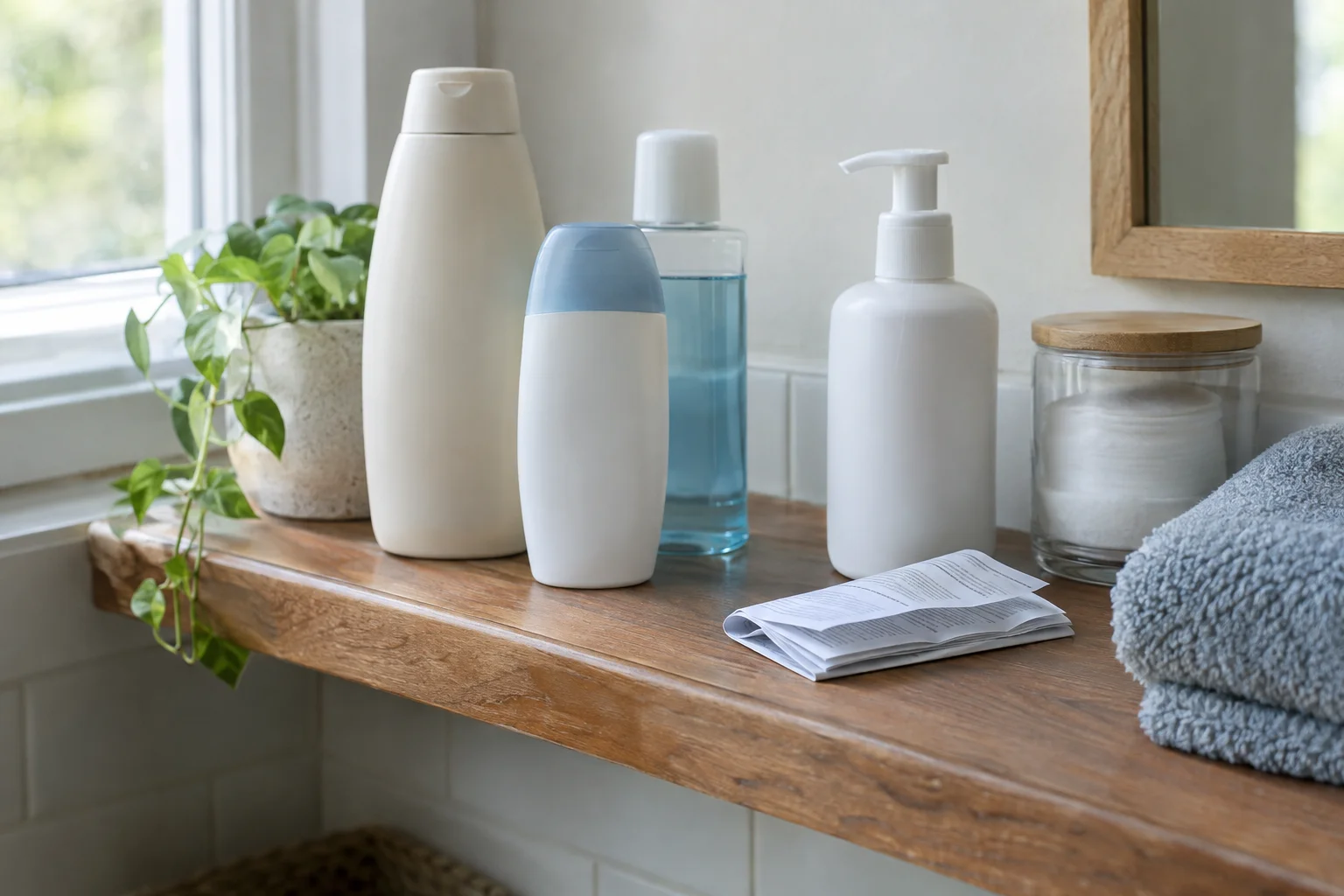
Disulfiram and Alcohol-Containing Products: Safety
Disulfiram and alcohol-containing products can interact beyond drinks. Learn which everyday exposures need review and when symptoms require emergency help.
Disulfiram and alcohol-containing products can be a safety concern even when no alcoholic drink is involved. Some medicines, foods, toiletries, and household products deserve attention. Follow the prescribed precautions, review uncertain products with a pharmacist, and seek emergency help for severe symptoms. MedlinePlus explains these disulfiram precautions.
A cough syrup or familiar toiletry may not feel connected to alcohol treatment. Yet the purpose of a product does not settle whether it fits disulfiram precautions. Medication guidance identifies several overlooked sources of alcohol, while a pharmacist or prescriber can address uncertainty about a specific product. Household routines can help make the prescribed precautions easier to follow. There is no universal safe-exposure threshold or substitute for individual medication instructions. You do not need to deliberately experience a reaction to understand the warning, and an accidental exposure deserves medical attention rather than blame.
Why can alcohol outside a beverage matter during disulfiram treatment?
Alcohol outside a beverage matters because disulfiram precautions concern alcohol exposure, not simply the decision to have a drink. Our guide to how alcohol use disorder medications differ provides the broader context, while Women’s Recovery’s substance-use care information explains how alcohol concerns fit alongside mental health and trauma care.
Disulfiram is an alcohol deterrent. It discourages drinking by causing unpleasant effects when alcohol is consumed, even in small amounts. Those effects may include flushing, headache, nausea, vomiting, sweating, weakness, confusion, chest pain, and breathing difficulty. This is a medication interaction, not a measure of someone’s motivation or honesty. MedlinePlus describes the purpose of disulfiram and the possible reaction.
A product can have a purpose unrelated to drinking and still belong in a medication-safety discussion. Cough syrup is used for symptoms. Cologne is used for fragrance. A sauce is part of a meal. None of those purposes, by itself, answers whether the product contains alcohol or whether its use conflicts with the prescribed precautions.
Three distinctions help keep the warning clear:
- Intent and exposure are different. An unintended exposure still deserves attention, without implying that someone chose to drink.
- A product category is not an ingredient list. The word “medicine,” “food,” or “toiletry” does not establish what is in the specific product.
- General education is not product clearance. Recognizing a category is useful, but a pharmacist or prescriber must resolve uncertainty about an individual product and treatment plan.
Disulfiram is also only one part of alcohol treatment. The National Institute on Alcohol Abuse and Alcoholism’s treatment guide describes medication, counseling, and recovery support as treatment options. Product precautions serve a specific safety purpose; they do not replace the broader work of recovery.
Which product categories deserve pharmacist or prescriber review?
Medicines, certain foods and beverages, topical products, and some household or workshop products deserve attention. MedlinePlus specifically names cough syrup, sauces, vinegars, aftershave, cologne, rubbing alcohol, paint, paint thinner, varnish, and shellac in its disulfiram precautions. These examples identify areas for review, not a complete list of safe and unsafe brands.
| Category | Examples named in the guidance | Why the category matters |
|---|---|---|
| Medicines taken by mouth | Alcohol-containing cough syrup | A medicine can introduce alcohol even when it is being used for an unrelated symptom. |
| Foods and beverages | Sauces, vinegars, and foods or beverages containing alcohol | Meal ingredients belong in the precautions, along with alcoholic drinks. |
| Fragrance and grooming products | Aftershave lotions and colognes containing alcohol | Use on the skin should not automatically be treated as outside the warning. |
| Other topical products | Rubbing alcohol | A familiar first-aid product still needs consideration under the medication guidance. |
| Household and workshop products | Paint, paint thinner, varnish, and shellac | The guidance warns against contact with or breathing fumes from these alcohol-containing products. |
For medicines, the important detail is the actual formulation, not merely the symptom being treated. A cough product should not be assumed suitable because it is sold without a prescription or has been used before. The disulfiram guidance also calls for review of prescription and nonprescription medicines, vitamins, supplements, and herbal products because medication interactions may require additional precautions.
For food, it is useful to separate the name of a dish from its ingredients. Knowing that something is a dessert, dressing, or sauce does not establish whether it meets the prescribed restrictions. The source specifically includes sauces and vinegars, so a general assumption that food is different from drinking is not enough.
For topical and household products, the way you encounter a product matters to the discussion, but it does not automatically settle it. MedlinePlus warns that alcohol-containing products applied to the skin may cause symptoms and separately warns about contact with or inhalation of certain product fumes. Do not turn that into the claim that every household bottle presents the same risk. The practical issue is the specific product, the proposed use, and the instructions that apply to you.
Why are label assumptions not a personalized safety decision?
A label provides information about a product, but it cannot account for your medical history, other medicines, or prescribed disulfiram precautions. MedlinePlus directs patients to discuss medicines and health conditions with their doctor or pharmacist. Reading a label is useful, but an uncertain interpretation should not become permission to experiment.
Consider the difference between identifying an ingredient and deciding what to do. Seeing alcohol named on a label identifies something relevant to the warning. It does not establish an acceptable amount, exposure route, or exception for your situation. Conversely, not noticing alcohol during a quick glance is not the same as having the exact product reviewed.
Broad descriptions can also answer a different question from the one you need answered. “For sensitive skin” describes a product’s intended use or marketing. “Nonprescription” describes how a medicine is obtained. Neither statement is a personalized assessment of compatibility with disulfiram. An “alcohol-free” claim may be relevant information, but it does not review other ingredients or other medication interactions.
Food preparation creates another opportunity for assumptions. A recipe’s use of heat is not, by itself, proof that the finished dish fits your prescribed precautions. Rather than treating a cooking method as clearance, keep the decision connected to the medication instructions. MedlinePlus advises avoiding foods and beverages containing alcohol and explicitly includes sauces and vinegars.
General guidance does not establish a universal safe amount for an uncertain product. MedlinePlus states that even small amounts of alcohol can cause unpleasant effects with disulfiram. A previous uneventful use is not a reliable reason to deliberately repeat an uncertain exposure. A lack of symptoms on one occasion does not replace the prescribed warning.
The goal is not to make every ordinary product feel threatening. It is to recognize where general knowledge ends. A specific answer from a pharmacist or prescriber is more useful than a rule based only on familiarity, advertising, or someone else’s experience.
How can household routines account for the prescribed precautions?
Household routines can make the prescribed precautions easier to follow by keeping reviewed products identifiable and avoiding casual substitutions. These routines should reflect the actual medication plan rather than a homemade list of universal prohibitions. MedlinePlus’s product warnings and instructions to consult a doctor or pharmacist provide the safety basis.
A useful household approach reduces guessing at the moment a product is needed. For example, keeping a medicine in its original labeled container preserves the information needed to identify it. Keeping a reviewed toiletry separate from a similar-looking unreviewed product can prevent confusion. These are organizational suggestions, not evidence that a particular product is safe.
- Keep exact products recognizable. A familiar bottle or package makes it easier to distinguish what has been reviewed from what has not.
- Avoid treating substitutions as equivalent. A replacement cough medicine, fragrance, or cooking ingredient should not inherit another product’s safety decision merely because it serves the same purpose.
- Include relevant household tasks. Painting, refinishing, and similar activities belong in the discussion because the medication guidance addresses contact and fumes.
- Share only the practical information others need. A person helping with shopping or cooking can respect a product restriction without receiving your full treatment history.
Support should remain informed and voluntary. MedlinePlus explicitly warns that disulfiram must never be given without the patient’s full knowledge. A loved one’s concern does not justify hiding medication in food or using a possible reaction as a threat. The purpose of household support is to make the agreed precautions workable, not to monitor or punish someone.
Precautions also do not necessarily end when the medication is stopped. The MedlinePlus warning states that an alcohol reaction may occur for up to two weeks after disulfiram has been stopped. Its precaution instructions also advise avoiding alcohol for several weeks afterward. Do not use a general countdown to decide when an uncertain product becomes acceptable. The prescribing clinician should clarify how long the restrictions apply, and medication changes should not be made independently.
When should a suspected reaction prompt 911?
A suspected reaction needs emergency help when severe symptoms occur, including the warning signs highlighted above. Do not wait to prove which ingredient caused the problem before calling 911. MedlinePlus identifies chest pain and breathing difficulty among alcohol-reaction symptoms and directs immediate emergency help for collapse, seizures, breathing trouble, or inability to wake someone.
Less severe symptoms after a possible exposure still warrant prompt professional guidance. Flushing, nausea, headache, or sweating should not be used as a home test of whether a product is compatible. Stop using the suspected product and contact a medical professional for guidance. Do not deliberately repeat the exposure, attempt to provoke a clearer reaction, or change disulfiram on your own.
A reaction and a medication side effect are not always distinguishable by symptoms alone. MedlinePlus also lists unusual tiredness, loss of appetite, vomiting, yellowing of the skin or eyes, and dark urine as reasons to call the doctor immediately. A person should not assume that every new symptom is an alcohol reaction or dismiss it as an expected part of treatment.
For a suspected overdose, call 911 immediately. Poison Control at 1-800-222-1222 can also provide guidance about accidental ingestion or poisoning concerns, but contacting it must not delay emergency help. The MedlinePlus disulfiram emergency section provides poison-control information and emergency warning signs. A routine treatment inquiry is not a substitute for emergency assessment.
For ongoing support in Denver, CO, Women’s Recovery offers outpatient mental health, trauma, and substance-use programs, including PHP and Intensive Outpatient Program (IOP) care. It does not provide onsite detox, residential, or inpatient services. Medication selection and product-specific advice belong with your prescriber or pharmacist. For nonemergency program information, contact Women’s Recovery or call 833.754.0554.
Frequently asked questions
Can some cough medicines contain alcohol?
Yes. MedlinePlus specifically identifies alcohol-containing cough syrup in its disulfiram precautions. A medicine’s purpose does not establish that it is compatible with treatment. Have the exact formulation reviewed by a pharmacist or prescriber rather than assuming that every cough product, or every nonprescription medicine, has the same ingredients.
Should topical products be included in a safety discussion?
Yes. MedlinePlus names alcohol-containing aftershave lotions, colognes, and rubbing alcohol and warns that topical exposure may cause symptoms. It also addresses contact with or breathing fumes from certain household products. Do not assume that use outside the mouth automatically removes a product from disulfiram precautions; obtain guidance about the specific product.
Does stopping disulfiram immediately remove every alcohol precaution?
No. MedlinePlus warns that an alcohol reaction can occur for up to two weeks after disulfiram has been stopped, and its precaution section advises avoiding alcohol for several weeks afterward. The prescribing clinician should clarify the applicable restrictions. Do not stop medication independently or use a general timeline to clear an uncertain product.
Is deliberately testing an alcohol reaction a safe way to learn?
No. MedlinePlus states that even small amounts of alcohol can cause unpleasant effects with disulfiram, including chest pain and breathing difficulty. Deliberately testing a drink or uncertain product is not a safety assessment. Follow the prescribed precautions, obtain product-specific guidance, and call 911 immediately if severe symptoms occur after an exposure.