
Choosing care can feel overwhelming. If you are comparing inpatient and outpatient rehab in Denver, this guide explains the difference, helps you decide what fits your life, and explains how to build a safe, flexible plan that supports recovery.
What’s the difference between inpatient and outpatient rehab?
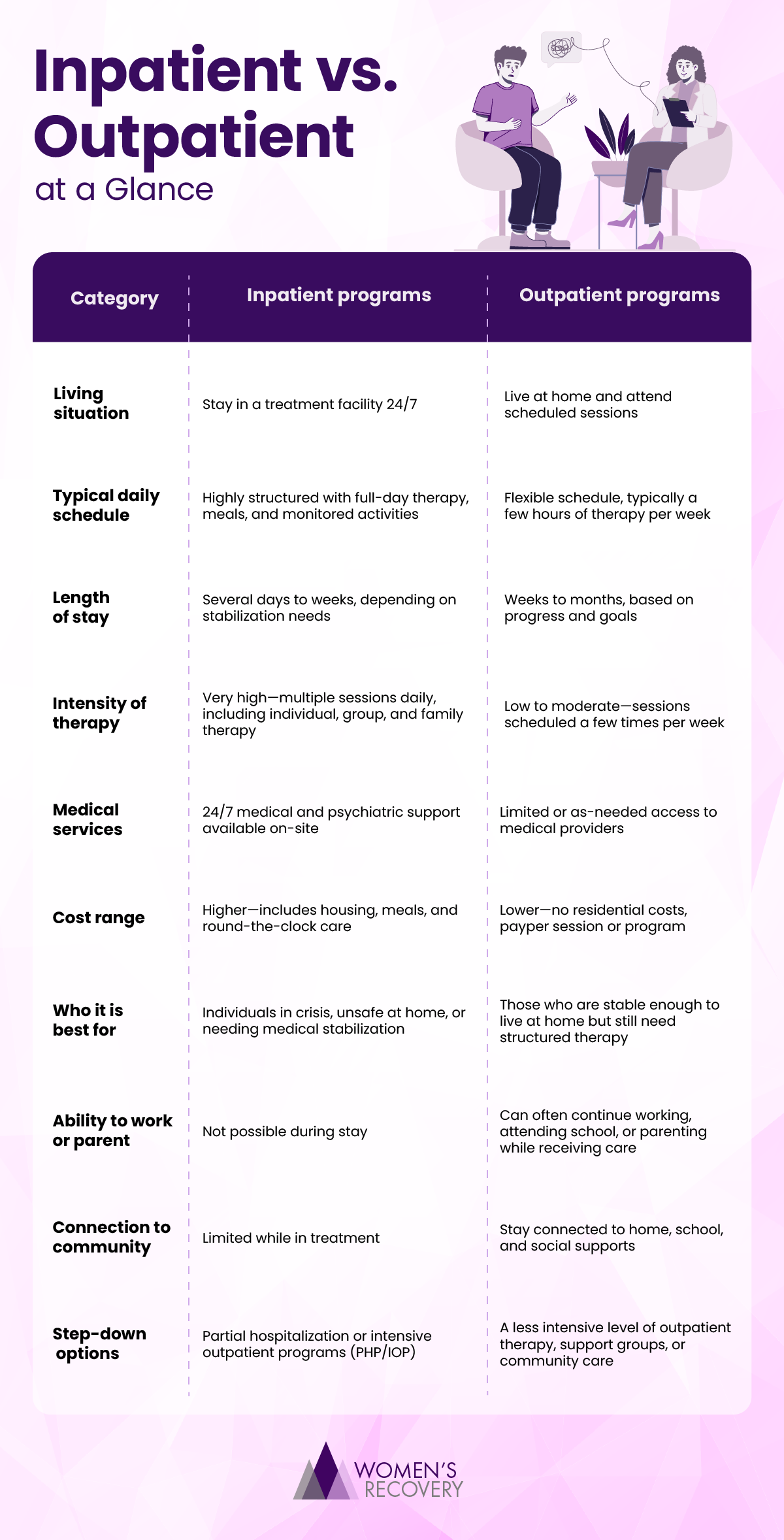
Inpatient treatment means you live at the treatment facility while you receive care. Many inpatient programs are residential treatment settings with 24-hour support, structured schedules, and continuous monitoring. Some programs are hospital-based, often called inpatient care, where medical teams provide higher levels of medical care and medication management.
Outpatient rehab means you live at home or in recovery housing and attend therapy on scheduled days. Outpatient programs range in intensity:
- Partial hospitalization programs (PHPs) are the most intensive outpatient services. Women attend most of the day, usually 5 days per week, then return home at night.
- An intensive outpatient program (IOP) provides multiple therapy sessions on several days each week. IOP treatment is common for step down after inpatient treatment or for women who need more structure than weekly therapy.
- Standard outpatient care (SOP) involves 1 to 2 therapy sessions per week.
How does detox fit into rehab options? Detox is different from rehab. Some people need medically managed withdrawal from a substance for a few days before starting therapy. Detox can occur in a hospital or residential program, then care transitions to day treatment, IOP, or weekly therapy.
How inpatient treatment works
Inpatient treatment is a highly structured program with:
- 24-hour support and continuous monitoring
- Access to medical care, including medication management when appropriate
- Daily individual therapy and group counseling
- Education on relapse prevention, coping skills, and mental health
Length of stay varies by treatment center and insurance. Many residential treatment programs last around 28 to 30 days, although some stays are longer. The average stay in hospital-based inpatient care can be shorter, sometimes a few days, especially for stabilization or detox before step down.
How outpatient programs work
Outpatient care helps you recover while staying connected to home, work, and school. An intensive outpatient program balances structure with flexibility:
- Multiple therapy sessions per week, often including group therapy and individual therapy
- Skills practice that fits into daily life, like managing cravings after work
- Coordination with support groups and community resources
For many working moms in Denver, IOP or day treatment is a strong fit. You can attend morning or evening sessions, then return to family duties. Outpatient treatment for professional women can be aligned with career demands and privacy needs.
Our outpatient options address co-occurring mental health conditions such as anxiety, depression, trauma, and mood disorders. Your treatment team may recommend mental health treatment, including medication management when appropriate, as part of an individualized treatment plan.
Questions to help you choose the right level of care
Outpatient drug and alcohol addiction programs can be a good entry point for moderate substance use or as a step down after inpatient rehab. Here are some things to think about when considering inpatient vs. outpatient rehab:
- Safety first: Can you stay sober at home without 24-hour supervision, or do you need inpatient care for stabilization?
- Severity: Are you managing moderate substance use or severe substance use that disrupts daily life?
- Triggers at home: Do you have a stable living environment, or would moving to a more supportive environment help?
- Health needs: Do you have co-occurring mental health concerns that require concurrent care?
- Parenting and work: What schedule helps you meet family, school, or job commitments?
- Community support: Can you use support groups and community supports to stay engaged between sessions?
- Readiness: Are you able to attend group sessions and one-on-one sessions consistently?
Sometimes the choice is obvious; when it isn’t, a clinical assessment can help match you to the appropriate level of care.
Denver resources for both inpatient and outpatient rehab
Finding the right care in Denver is easier when you know where to start. You can use SAMHSA’s Treatment Locator to search for detox, residential treatment, partial hospitalization programs, and outpatient programs near you.
Why Women’s Recovery specializes in outpatient care
Outpatient care can be a powerful option for women who want flexible, high quality support that fits into daily life. Women’s Recovery focuses on gender-responsive, trauma-informed outpatient programs designed to address substance abuse and mental health together. These offer:
- Flexible scheduling throughout the week, including a virtual IOP option
- Evidence based modalities that support coping skills, relapse prevention, and long-term recovery
- Care that respects women’s roles, including parenting, caregiving, and professional demands
Review Women’s Recovery treatment programs to learn how outpatient care can support your recovery journey in Colorado.
Frequently asked questions
Neither is universally better. The best choice matches your needs. Inpatient treatment is often recommended when safety is a concern, withdrawal risk is high, or home is not supportive. Outpatient rehab can be effective for individuals seeking treatment who have a safe home, reliable transportation, and the ability to attend frequent sessions.
Success depends on the quality of addiction treatment, the match to your mental health needs, treatment duration, and ongoing support.
It varies by program and insurance. Many residential programs last 28 to 30 days. Hospital-based inpatient care for stabilization can be shorter. Outcomes improve when treatment continues after discharge through outpatient programs and support groups.
Choose inpatient treatment when:
- You cannot maintain safety or sobriety at home
- You need 24-hour access to a treatment team and medical monitoring
- You have severe alcohol addiction or complex co-occurring disorders
- You need structured separation from triggers to reset your recovery
After discharge, step down to day treatment or an intensive outpatient program to continue progress and build long term recovery supports. Ongoing treatment supports recovery and helps you sustain change over time.
People often use these terms interchangeably. In general, inpatient care refers to hospital-based programs with higher medical intensity, while residential treatment means a non-hospital setting with 24-hour support.
If you need medically supervised detox, complete that first at a licensed treatment facility, then transition to PHP or IOP for ongoing treatment. Your healthcare provider or prospective outpatient provider can recommend an appropriate medical detox center.
IOP is a form of rehab. It is outpatient care with more intensity than weekly counseling, often including group therapy, individual sessions, and skills practice several days per week.
Standard outpatient programs usually include 1 to 2 therapy sessions per week. IOP provides more hours and more frequent contact with your treatment team.
Parenting, work, and flexible recovery
For working moms, an intensive outpatient program can fit around school pick-up and work schedules. Programs often offer morning or evening therapy sessions, allowing you to practice skills in daily life. If you are balancing childcare, ask how groups are scheduled and whether telehealth options are available for certain services.
Women with co-occurring mental health, including mood disorders or trauma, often need integrated care. Outpatient programs can address mental health and substance abuse treatment together, helping you learn skills while staying present at home.
You do not have to do this alone. If you are ready to take a next step, call Women’s Recovery at 833.977.3289 or reach out online to find out more about outpatient options for women in Denver.